
By Cat Woods – Apr 08, 2026 11:43 am AEST
As New South Wales faces a rental vacancy crisis, the demand for housing beyond traditional units and houses has stretched to tiny houses, granny flats, motorhomes and caravans. The call for greater leniency around houseboat residence is also growing, especially from residents along the Murray River.
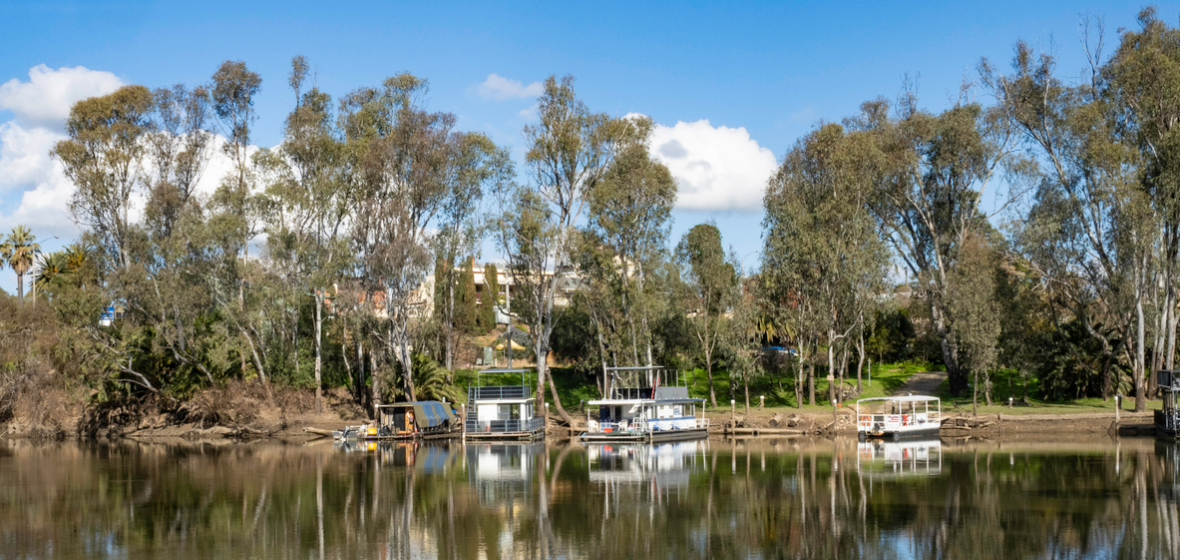
In May 2024, the ABC reported on retirees seeking cheap and comfortable homes on the water – unburdened by rates, water or electricity bills. The “blanket ban” in NSW was an anomaly, as one retiree, Dr Bill Phillips put it. Phillips was living, at that time, in a small inlet off the Murray River – Bruce’s Bend Marina – that fell into Victorian waters.
In response to ABC inquiries, a New South Wales Transport spokesperson claimed that “living in houseboats was not allowed because of safety risks, pollution concerns and increased noise and anti-social behaviour”. The rental vacancy in Mildura at that time was less than 1 per cent of homes.
Permanent residency on a houseboat in NSW waters is banned. Houseboats on Crown land in NSW are regulated by the Department of Planning, Housing and Infrastructure – Crown Lands and Transport for NSW.
In response to enquiries, Transport NSW (TfNSW) informed LSJ Online that there are 863 currently registered houseboats in NSW.
Houseboats have been prohibited on Sydney Harbour since 2005. TfNSW clarifies that there are currently only two houseboats remaining on the Harbour, both of which have existing use rights. Each operates under a lease arrangement and pays rent in accordance with the Independent Pricing and Regulatory Tribunal Act 1992 (NSW)(“IPART Act”) recommendations.
TfNSW explains that the existing tenure arrangements are in place because the two houseboats on Sydney Harbour provide permanent residential accommodation and are located at fixed mooring locations in Middle Harbour at Pearl Bay and Fisher Bay. The houseboat at Pearl Bay has a physical connection to the adjoining terrestrial land for access and servicing. Servicing infrastructure for the houseboat at Fisher Bay is also provided from the adjacent terrestrial land.
Under the IPE Infrastructure Management System’s “Maritime Property Guide – Establishing Domestic Waterfront Leases and Licences”, regulations apply to all new and renewed agreements (or “leases”) issued over TfNSW land for structures and uses associated with a private residence and used for a private, non-commercial purpose – these structures and uses include, but are not limited to, boatsheds, private landing facilities, mooring pens, private marinas and reclaimed lands. Last reviewed in June 2025, it is again due for review in 2027.
Outside of Sydney Harbour, Crown Lands are the owners of the seabeds including Botany Bay, Yamba, Eden and Port Kembla, and are responsible for providing landowner consent for a houseboat to be floating but attached to the shore outside of TfNSW Maritime owned areas.

“NSW is generally considered the most restrictive and expensive state for houseboat ownership and operation compared to Queensland and Victoria.”
Vaarzon-Morel says, “From my observations on Lake Macquarie, leniency has already been taken for a number of years with respect to people living on boats. The problem is Maritime could turn at any stage and cause these illegal occupants to be turfed out. The laws were not so prescriptive in the past. Previous enforcement in NSW was often the result of complaints from wealthy waterfront owners.”
He says that nationally, “NSW is generally considered the most restrictive and expensive state for houseboat ownership and operation compared to Queensland and Victoria.”
That’s largely owing to the fee structure and periodic renewals that are waived in other states, Vaarzon-Morel explains.
In Queensland, local councils have specific anchoring limits, but the state generally allows a capped number of permanent houseboat licences in designated areas. Victoria, likewise, allows a capped number of long-term houseboat licences, particularly on the Murray River.
Lawyers advising boat owners and operators need to know the national, state, and local laws
As the owner or operator of a houseboat, or a lawyer advising a client with plans to own a houseboat, marine legislation applicable to Australia, NSW, and local councils is fundamental.
The Environmental Assessment and Planning Act 1979 (EP&A Act), the State Environmental Planning Policy (Infrastructure) 2007 (SEPP), and relevant State, Regional and Local Environmental Plans all govern where houseboats can be navigated and moored, the necessary permits and licenses, waste and sewage disposal rules, and what conditions deem it unsafe to operate or travel in the waterways. Local Boating Safety Officers have the most up-to-date information.
Leo Patterson Ross, CEO of the Tenants Union NSW, says, “We generally would think people should be able to live in a range of options, so long as they are sufficiently safe and healthy environments, and you can control your space and access to it. Currently, that might not be the case with houseboats in NSW.”
However, he says he could imagine an advocate convincing the Tribunal that ‘the premises’ for the purposes of the contract includes only the boat itself, and so its specific location on mooring is less relevant.
Internationally, by contrast, there are approximately 2,500 to 2,900 houseboats used as residential dwellings in Amsterdam with no further permits available. These tend to be converted cargo ships or more luxurious floating villas, which are permanently moored along the canals and connected to city utilities. The culture of permanent residency on the water burgeoned after WWII due to housing shortages and damaged housing, though the cost is prohibitive at between €500,000 ($A837,365) and over a million ($A1.66m). Further, there are maintenance expenses, a parking permit, taxes and an insurance that is often more expensive than a normal house.
In the US, there are houseboat communities in Washington, Oregon, California, Florida and New York. In Canada, Toronto and British Columbia host floating home communities. Srinagar and Kerala in India, Penang in Malaysia, Hong Kong, and Ha Long Bay in Vietnam are home to longstanding houseboat villages.